
Curator: Yehudit Matzkel
Leafing through a family album is a highly charged experience familiar to us all. At times, it seems as though our memory of a happy, carefree childhood is shattered when confronted with the feelings evoked in us as we turn the pages. Glezerman conjures up and studies images from the family album through the act of painting - traditional, classical painting that converses with its history. In the work Dan, she depicts a boy dressed as Superman standing on a chair. His costume is oversized, making him look ridiculous and pitiful, the complete opposite of the omnipotent superhero. Yet despite the strong feeling of misery emanating from the image, Glezerman's own point of view is empathic, intended neither to ridicule nor to caricaturize the depicted figure. According to the artist, the painting was influenced by the dwarf paintings of the 17thcentury Spanish artist Velázquez: "Like the Infanta in Velázquez'sLas Meninas, Dan appears uncomfortable and embarrassed in his costume, put on display as an object for the viewer to behold."
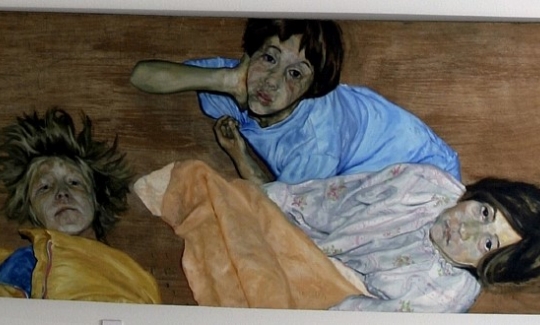
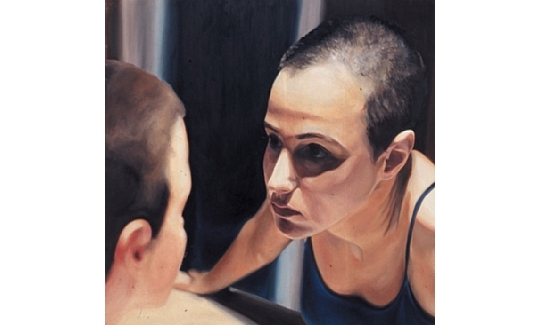
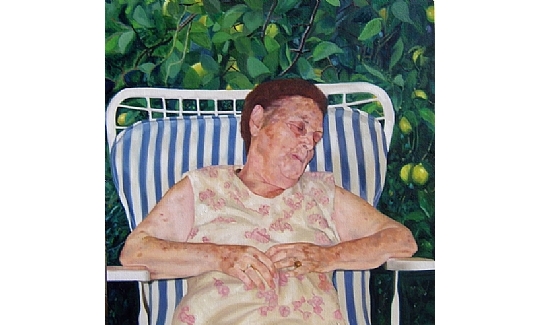
In all the paintings, the figures are located in undefined, unfamiliar settings. The painting Tamar, Josh and Rebecca, for instance,portrays three young children asleep in the backseat of a car. The landscape seen through the window is nondescript and insubstantial. Despite the children's sweet faces, the eye is made uneasy by the sight, which evokes a sense of loss. Another element which recurs in many of the paintings is the figures' often-shut eyes; this physical gesture creates an elusive reality, making it unclear whether the figures are resting, comatose or sleeping an eternal sleep. Asked whether her paintings are real portraits or echoes of distant childhood memories, the artist replied: "In my self-portraits I try to fold back into my childhood bed, to return to a primal, protected place that existed before the violation of order, while being conscious that this world no longer exists."
Shira Glezerman was born in Tel Aviv (1975). She is a M.A candidate at the Multidisciplinary Program in the Arts, Tel Aviv University, and studied drawing and painting in the Jerusalem Studio School under the supervision of Israel Hershberg (2000-2001). She is a Graduate of the Fine Arts department, Bezalel Academy of Art and Design, Jerusalem (1996-2000). Glezerman participated in the group exhibition "Playing Hide and Seek" at the Bernard Gallery of Art, Tel Aviv (2005). Her work Self Portrait (1999) was printed on the cover of David Grossman's book: Someone to Run With (New Library publication, 2000). She lives and works in Tel Aviv.
Curator: Yehudit Matzkel
In this exhibition, Orimian creates a mysterious, enigmatic narrative suspended between reality and imagination. At the center of the exhibition are two life-size portraits of a young woman and man, which appear like frozen, fragmented cinematic images. Although their names are specified, it is unclear whether these are real figures or stereotypes representing "Man" and "Woman." In contrast to these two figures, which stand silently while directing a disturbing gaze at the viewer, the group of small paintings is characterized by a different painterly language - the figures are fragmented, headless, and giddy. Since the story's margins are unraveled, unearthing only parts of it, the viewers are invited to ascribe a narrative logic to the painterly sequence and to assign it a suitable cinematic genre: horror, drama, tragedy, or even a melodrama about impossible love.
Orimian's works introduce voyeurism as a major theme: he gathers his images in the course of randomly surfing blogs on the web, thus inevitably transforming the viewers themselves into voyeurs. These digital images are then transformed through the language of painting, raising questions about the traditional medium of painting's relevancy in relation to the photographic image. As Orimian notes, "the painting exploits the digital medium to release it from its boredom, while seeking the bright side concealed in those amateur, careless photographs, transforming them into 'street poetry' in the language of painting." The act of painting appropriates photography, relying on it and utilizing it. The result is an abstraction of reality; the more we try to capture it, the more unattainable it becomes. The paintings remain a mute testimony to the narrative event and to the act of painting; like the living-dead, they oscillate between the terms "still" and "life."