
Exhibitions
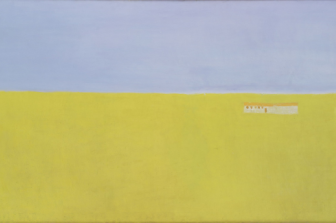
Northern Horizon: A New Perspective on 1970s Landscape Painting in Israel
New exhibition
The Haifa Museum of Art collection, which provides the foundation for this exhibition, reveals a very different 1970s: years of richly colored oil painting, whose forms are grounded in the visible place. The artists whose works are featured here all observed the local landscape closely, rendering it while applying the lessons of contemporaneous international art. They demonstrate a profound internalization of these tendencies that sought to reduce artistic expression to uniform color surfaces and abstract, universal forms, while infusing it with local content and conceptualizing the very essence of the landscape.
Saturday, 27.06.26
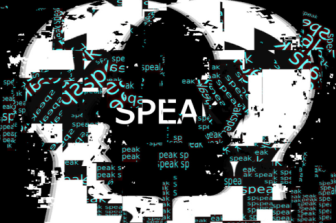
Laila Abd Elrazaq & Dana Mazal Ziv: Mother Tongue
New exhibition
The exhibition emerged from a collaboration between Laila Abd Elrazaq and Dana Mazal Ziv—a video artist and a composer—who, within the framework of the Haifa Museums' Space for Community Art Incubator, invited Arabic speakers from various local communities to reflect on their relationships with language. Excerpts from the interviews are played in the intimate listening booths, accompanied by textual video works in Arabic, Hebrew, and English, which shift between translation of the uttered words and their distortion, visually illustrating how the multiplicity of languages is sometimes experienced as a disturbance. Interview fragments were rendered as choral compositions, which envelop the space.
Saturday, 27.06.26
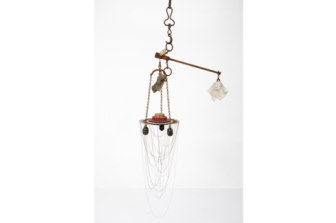
Moshe Roas: Knop and Flower
New exhibition
Moshe Roas's work intuitively fuses diverse, seemingly incongruent materials into a sculptural creation that finds points of equilibrium between weights and textures, between above and below, giving rise to a new material and visual conceptual world. Following a sustained engagement with the Museum's collection of objects from Morocco, characterized by a fusion of grandeur and mysticism, Roas was reminded of artisans of the past, of traditions of sculptural craftsmanship, and of the labor and precision invested in spectacular ornamentation that seeks to master matter and touch the sublime.
Saturday, 27.06.26
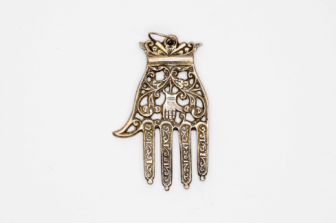
In Search of Lost Body: Moroccan Material Culture from the Museum's Collection
New exhibition
Whether a valuable artifact or a simple piece of cloth, an object is a container of life, carrying the memory of the body that wore it and the hands that crafted it. The physical aspect is present in every object in the exhibition, and all the works on view were made for the human body. For the first time in over 40 years, the exhibition reveals the treasures of the material culture of Moroccan Jews held in the museum, most of which were given to the Haifa Museum of Ethnology between 1950 and 1970 by immigrants from Morocco, mainly accomplished seamstresses and tailors.
Saturday, 27.06.26
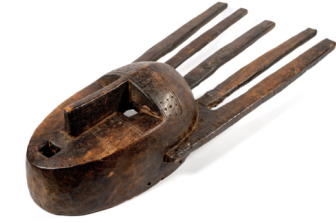
Africa Calling: The African Collection Revealed
Now at the museum
The Museum's collection of African ethnographic artifacts, which has remained hidden from public view for 30 years, includes approximately 1,000 pieces, donated by avid collectors and dedicated donors from around the world, who have intensely explored specific cultures and regions of Africa. These works were once exhibited at the Haifa Museum of Ethnology, founded in the early 1950s and active on Arlozorov Street until 1995. In unveiling these works again, "Africa Calling" calls on its viewers to immerse themselves in the diverse and vibrant cultures of Africa.
Saturday, 03.01.26

Desktop: A Physical Exhibition about a Digital Era
Now at the museum
For the exhibition, the Museum invited artists to create new works, exploring how digital thinking, concepts, and tools take on substance in the physical world, shaping artistic practice and material expression. Their works delve into what happens when digital aesthetics encounter physical limitations—people, matter, and unpredictability—and what it means when technology becomes an integral part of our bodies and identities.
Saturday, 03.01.26
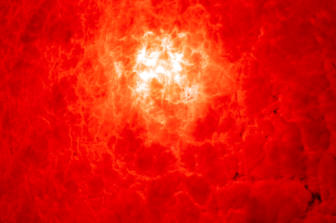
For Chaos They Yearn
Energy does not disappear or dissipate; it only changes form. In fact, since the Big Bang, the mass of the universe has been constant, only changing its shape and state of aggregation. Ella Littwitz revisits the ancient space around the Dead Sea and Mount Sodom, an area where the winds of Creation prevail. She explores the substances she finds there as being in the midst of change, a transformation in which the artistic act can take part.
Saturday, 22.02.25
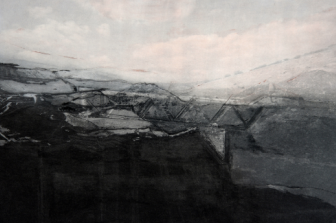
Lihie Talmor: From the Dark
The nuances, the different textures, the emanation of light or its concealment, what is highlighted and what is relegated to the shadows: in Lihie Talmor's works, every detail has a meaning and every action has a purpose. Her work is centered on a search for something that was lost, but left traces on site, despite the vicissitudes of time. The freedom inherent in printmaking enables reversal—transforming the documented into imaginary, and introducing tension between reproduction and fiction, between memory and invention. Through print, Talmor sheds light on dark chapters in the history of a place, uncovering truths and secrets hidden beneath the surface, and discussing the innate tensions between history, man, and place.
Saturday, 22.02.25
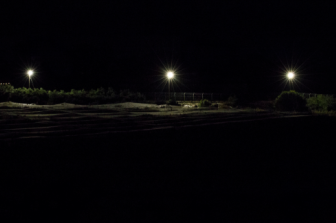
Hadar Saifan: Patrol
In her works, Hadar Saifan functions as a soldier: she spots aircraft, clears routes, patrols evacuated settlements, and shoots with her camera. The invasion of Israel in October 2023 reinforced the role of civilians in protecting their homes—people who felt they had been abandoned by the state and chose to fill the vacuum left by the official institutions themselves.
Saturday, 22.02.25
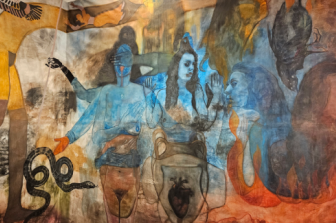
Merav Sudaey: Of Goddess Born
Merav Sudaey's exhibition space was transformed into a cave with painted walls, a ritual site for an ancient goddess. She draws inspiration from wall paintings in Hindu and Buddhist temples and monasteries, replacing all the figures with the image of one woman, her own. This painterly installation thus consists of a stratified series of self-portraits in which Sudaey examines her naked body as an object for painting while looking into herself as a subject. Applying diluted paint to the canvas, she heaps transparent layers one atop the other, which conceal or reveal spectral underlayers of female nudity. The two-dimensional canvas is rendered three-dimensional, as it were, as additional painterly worlds are waiting to be discovered under the top layer of paint.
Saturday, 22.02.25
Please contact us and we will contact you as soon as possible